Gemini 4 Argon vs Claude Opus 5.5: same prompt, same notes, one planet
Google released Gemini 4 Argon on 30 September 2026. As soon as it opened to us, we gave it exactly what Claude Opus 5.5 had on 22 September when it built its planet: the same request and the same project notes, word for word, and nothing more. It built one Three.js page on its own, in one go. We didn't nudge, retry or fix anything. What you play below is exactly what it wrote.
output a ThreeJS 3D cartoony/comics-like planet, with vibrant life on it: clouds, mountains, city buildings, cars and plane romaing it. It should be possible to orbit around and zoom and see the details. No harness is to be used
Gemini 4 Argon
Fullscreen ↗Claude Opus 5.5, 22 September
Fullscreen ↗Time and cost
| Model | Build time | Build cost | Looked at its own page? | Page size |
|---|---|---|---|---|
| Gemini 4 Argon | 5.5 min | $1.58 | no (tried once, its browser script failed) | 56 KB |
| Claude Opus 5.5 | 14.0 min | $2.54 | yes, three times | 48 KB |
| Claude Sonnet 5.5, average of 4 runs | 11.2 min | $1.69 | not measured | 28 to 41 KB |
| GPT-6 Sol, same notes | 7.1 min | $0.70 | yes, desktop and phone | 24 KB |
Cost is at each model's published API price. Argon is at Google's launch price: $2 per million input tokens, $10 per million output tokens, thinking counted as output, cached input 95% off. Opus's time is its build, after it had read the notes; the other models get the notes up front, so the windows match.
Same camera, both planets
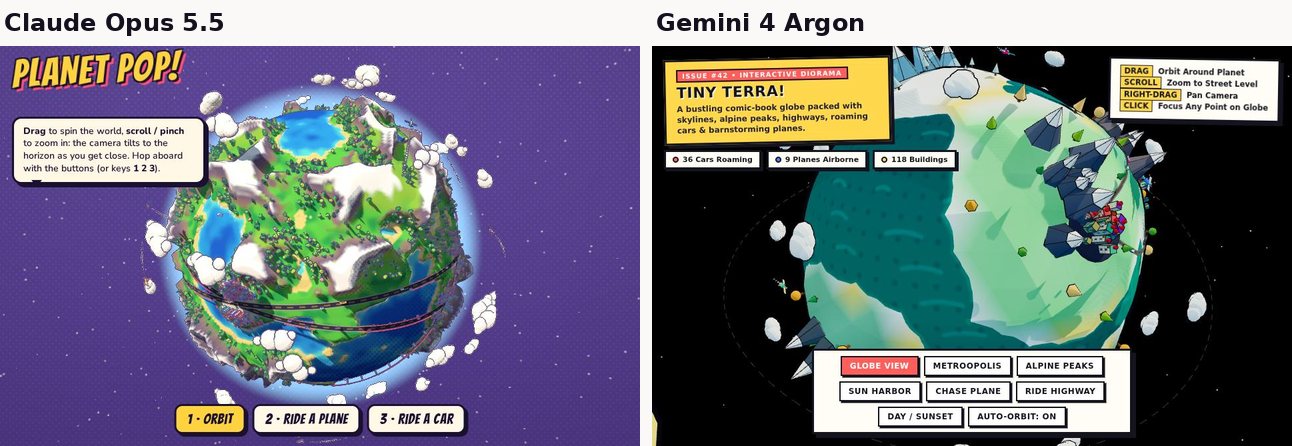
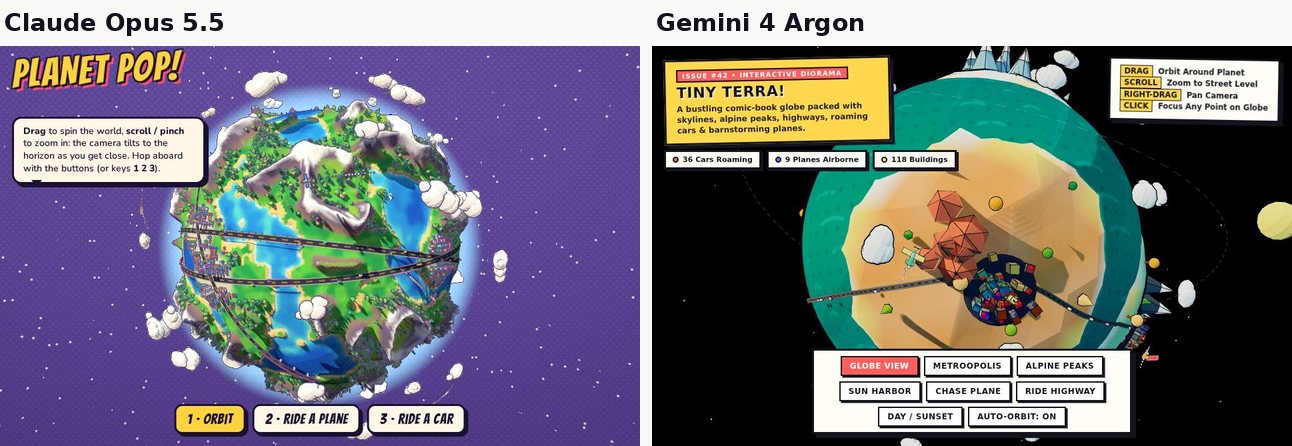
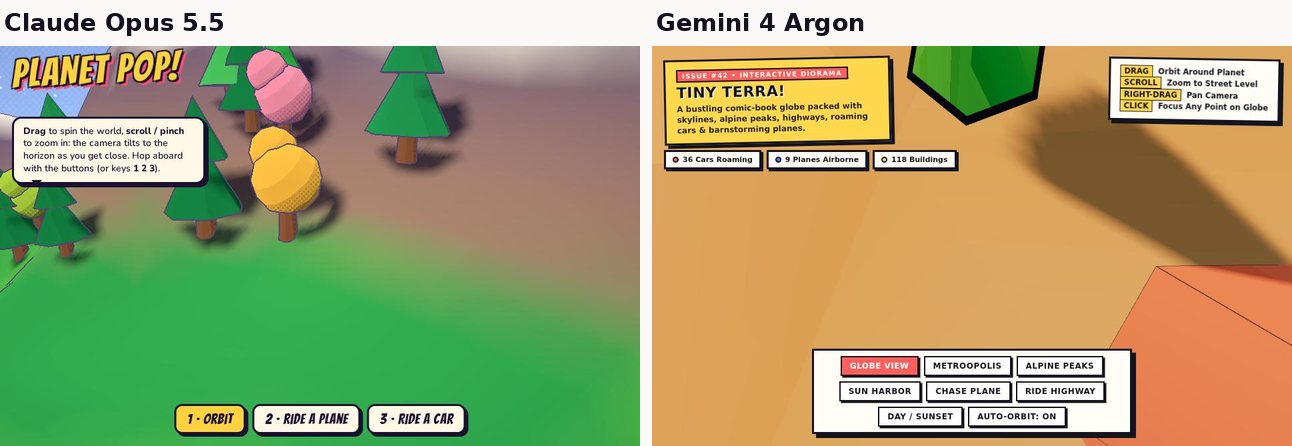
How we ran it
- Google's own agent, Gemini CLI 0.63.0, on Google Cloud Vertex AI, model
gemini-4-argon, default settings. Opus ran in Anthropic's own agent, Claude Code. - A sealed box with an empty home folder, Node.js and a headless browser it could use to look at its page. Nothing else from our servers.
- The prompt: Opus's 22 September request and the project notes it had read, 223 KB, word for word. Two changes: the model's name in "(you)", and one closing line asking for a single
index.html. Claude Sonnet 5.5 got the same text on 28 September. - 10 model requests and 11 tool calls. Wrote 41.9k tokens and thought 3.4k more.
| Model | Requests | Input | of which cached | Output | Thinking | Cost |
|---|---|---|---|---|---|---|
gemini-4-argon | 10 | 1132k | 599k | 41.9k | 3.4k | $1.58 |
What this does not show
- One run each for Argon and Opus. Models vary from run to run; Sonnet's four runs ranged from 7 to 15 minutes.
- No blind judge. Play both and decide.
- Argon is new and access is limited, so speed may change as Google opens it up.