Claude Fable 5.2 vs Opus 5.5, Sonnet 5.5 and Haiku 5.5: same prompt, same starting point
On 22 September, Claude Opus 5.5 built Planet Pop from one prompt, in 14 minutes for $2.54. Since then Sonnet 5.5 and Haiku 5.5 got exactly the same spot. Now it is Claude Fable 5.2's turn: the same instructions and notes Opus had loaded that day, the same message, and the same lookups Opus had already made before it wrote any code, word for word. Only the model's own name in the message changes. 4 runs, each a fresh one-shot: new session, empty folder, no memory of the other runs.
output a ThreeJS 3D cartoony/comics-like planet, with vibrant life on it: clouds, mountains, city buildings, cars and plane romaing it. It should be possible to orbit around and zoom and see the details. No harness is to be used
Time and cost
Measured from each session's own log (every request to the model), priced at Anthropic list rates. Fable 5.2: $8 in, $40 out, $0.20 cache read, $16 one-hour cache write per million tokens (twice Opus 5.5 on input, output and cache writes).
| Run | Time | Requests | Output tokens | List price | |
|---|---|---|---|---|---|
| Opus 5.5, 22 Sept (Planet Pop) | 14.0 min | 15 | 56.6k | $2.54 | one live session |
| Sonnet 5.5, average of 4 | 11.2 min | 11.5 | 64.9k | $1.51 | 7.0 to 15.2 min, $1.16 to $1.86 |
| Haiku 5.5, average of 4 | 5.3 min | 9.8 | 48.1k | $0.34 | 3.1 to 7.2 min, $0.27 to $0.42 |
| Fable 5.2, average of 4 | 27.0 min | 13.5 | 124.7k | $9.49 | 21.5 to 30.0 min, $7.62 to $10.65 |
| Fable 5.2, run 1 | 26.5 min | 17 | 127.4k | $9.96 | playable |
| Fable 5.2, run 2 | 21.5 min | 8 | 95.6k | $7.62 | playable |
| Fable 5.2, run 3 | 30.0 min | 14 | 129.0k | $9.71 | hit 30 min limit |
| Fable 5.2, run 4 | 30.0 min | 15 | 146.9k | $10.65 | hit 30 min limit |
Fable 5.2 cost 3.7x Opus 5.5, 6.3x Sonnet 5.5 and 28x Haiku 5.5 per planet ($9.49 vs $2.54, $1.51 and $0.34), and took 27 minutes against Opus's 14.
Sonnet's runs: 1 · 2 · 3 · 4. Haiku's runs: 1 · 2 · 3 · 4.
Sonnet 5.5's average is $1.51 (cache reads at the $0.10 list price), not the $1.69 our 29 Sept page first showed.
Play them
Drag to spin, scroll or pinch to zoom.
Other Fable runs: run 1 · run 2 · run 3
Same camera, every planet
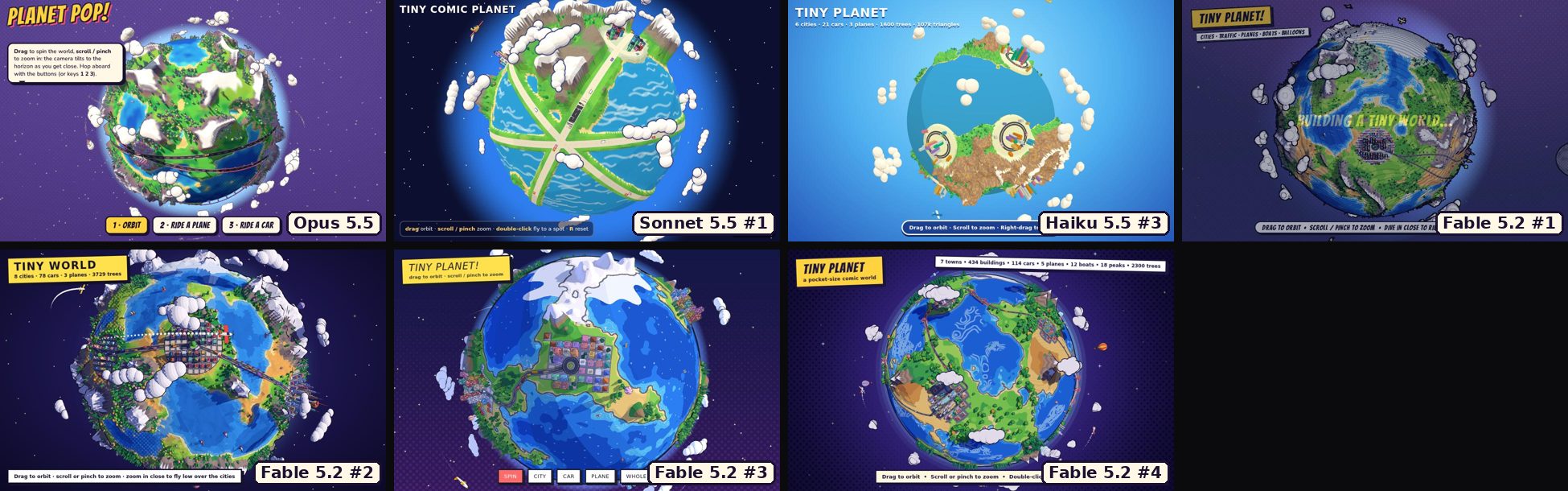
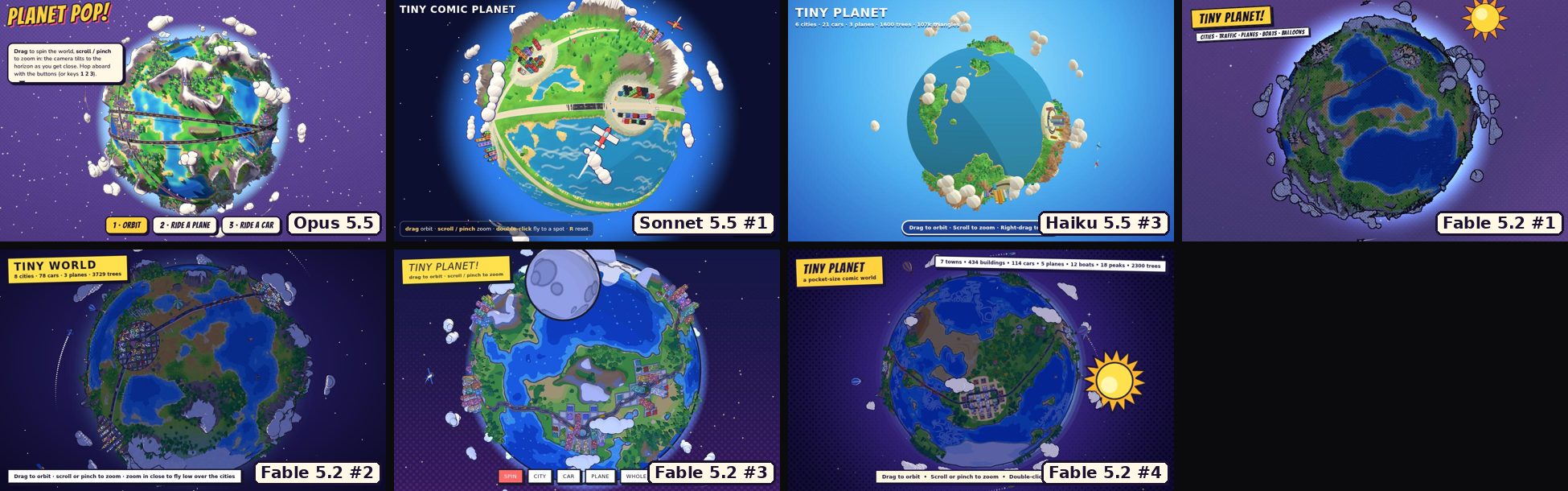
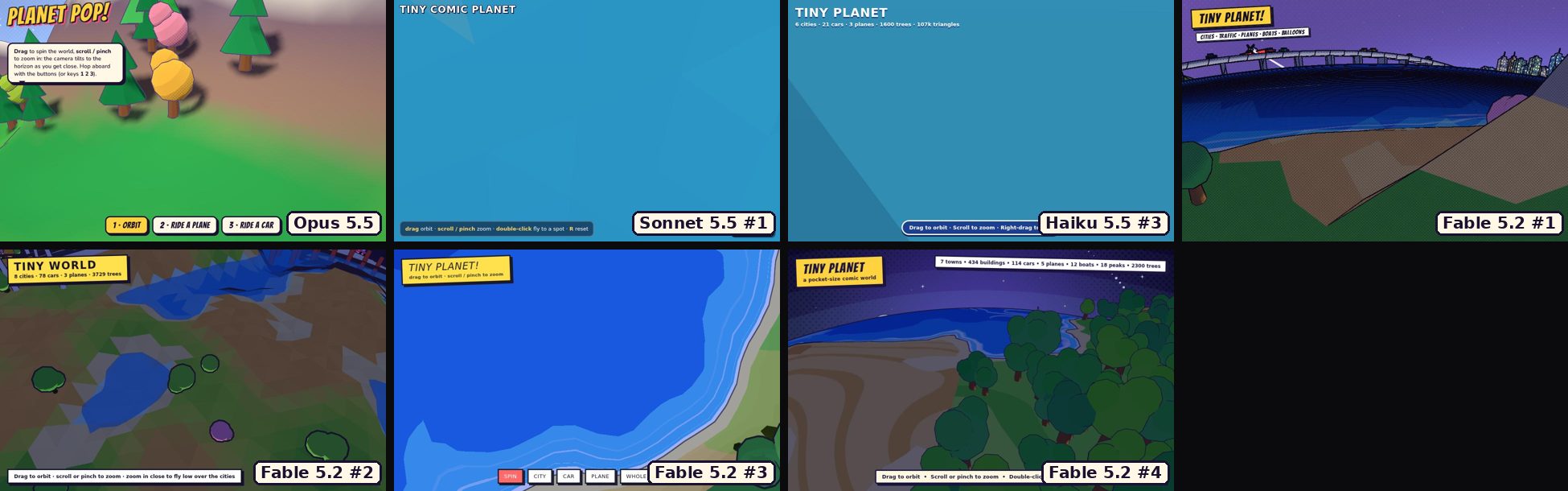
Opus 5.5, Sonnet 5.5 run 1, Haiku 5.5 run 3 (its best), then every Fable 5.2 run, captured by the same automatic check on a GPU.
Our take
- Price and speed: Fable 5.2 is the slowest and dearest Claude on this job. It averaged 27 minutes and about $9.50 a planet at list price, close to 4 times Opus 5.5 ($2.54) and 6 times Sonnet 5.5 ($1.51). Its list price per token is twice Opus's, and it wrote about twice as much (95k to 147k output tokens per run against Opus's 57k).
- It keeps polishing: runs 3 and 4 were still improving their planet when they hit our 30-minute limit (the same limit every model had). Both had already saved a playable page, and that page is what you see here.
- It always works: 4 of 4 runs gave a playable planet with cities, roads, cars, planes, clouds and mountains, and no errors.
- Look: the busiest planets of the series. Every run went for a comic look (ink outlines, halftone dots, a title sticker) and added extras nobody asked for: bridges, boats, balloons, a day and night cycle, a moon, a camera that flies down to a city. Run 4 shows 7 towns, 434 buildings and 114 cars, and zooming in lands you over a forest. Runs 2 and 3 are full from afar but show bare ground or sea when zoomed all the way in.
- Compare for yourself: play Fable's run 4 next to Opus's Planet Pop above and pick the one you prefer.
Tech stack
All are one self-contained HTML file using three.js from a CDN: no framework, no build step.
| Page | three.js | Post-processing | Custom shaders | Instanced meshes | Shadows | Size |
|---|---|---|---|---|---|---|
| Opus 5.5 · Planet Pop | 0.170.0 | yes | 5 | 12 | yes | 47 KB |
| Fable 5.2 · run 1 | 0.160.1 | yes | 7 | 1 | yes | 64 KB |
| Fable 5.2 · run 2 | 0.160.1 | no | 4 | 2 | yes | 55 KB |
| Fable 5.2 · run 3 | 0.160.1 | no | 3 | 5 | yes | 57 KB |
| Fable 5.2 · run 4 | 0.160.1 | no | 7 | 9 | yes | 77 KB |
What this does not show
- Opus has one run (the original 22 September session); Sonnet, Haiku and Fable have four each.
- Live session vs one-shot: Opus worked in a live Claude Code session; each Sonnet, Haiku and Fable run was a one-shot Claude Code call carrying the same context, effort high, 30 minute limit. They also had one extra rule: only write files in their own folder.
- Tool version: Fable 5.2 ran on Claude Code 2.1.321 (the first version that knows it; 2.1.319 and older reject the name). Haiku ran on 2.1.293, Sonnet on 2.1.284.
- Price is the list price a pay-per-token account would pay; we ran on a Claude subscription.
- Not blind, no real-GPU frame rate measured. Needs internet (three.js from a CDN).
Made by OhMyUnicorn Forge: describe an app in plain words, get a live URL.